Generic Banner Placeholder image

What’s New

Addiction treatment facility now has withdrawal management services — Peterborough Examiner

The 12-bed facility operates out of a renovated historic home at 24 Paddock Wood.

Article by Joelle Kovach, Peterborough Examiner

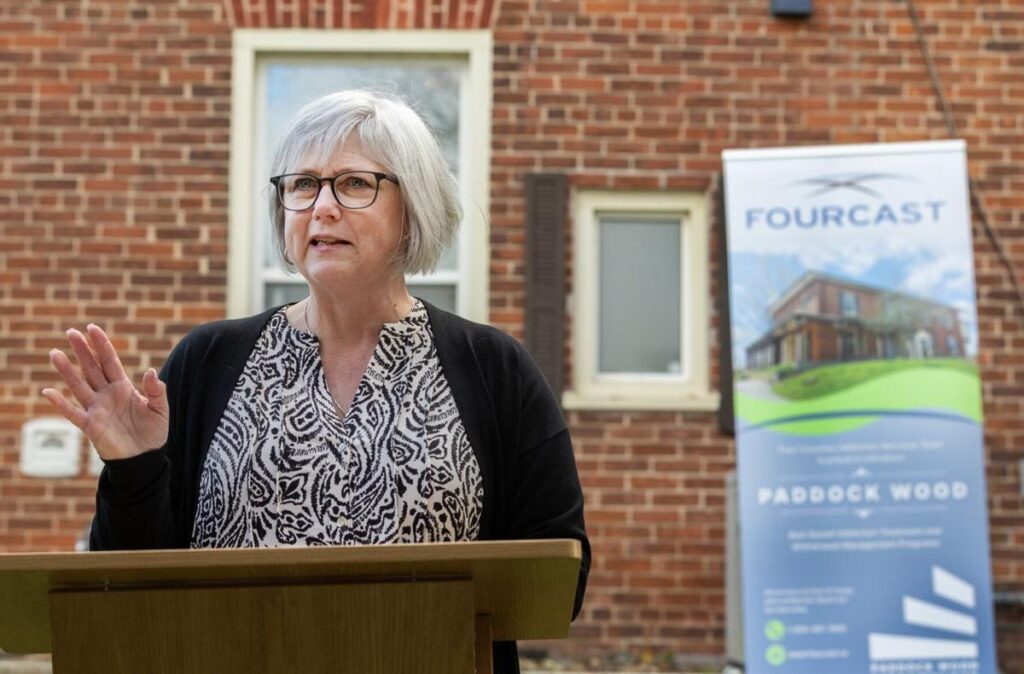
Paddock Wood, Peterborough’s first publicly funded addiction treatment facility, now has withdrawal management services.

The new service was added in late May and has not had a wait list since.

“That program has fairly easy access at this point in time,” said Donna Rogers, executive director of Fourcast (the addiction help agency that operates the facility). “I think we have open beds just about all the time.”

The 12-bed facility operates out of a renovated historic home at 24 Paddock Wood in Peterborough’s north-east end.

It helps men with addiction to alcohol or drugs. The nearest similar facility to Peterborough — in Oshawa — is for women.

Paddock Wood is the first facility of its kind in Peterborough. It has six beds in private rooms for withdrawal management (for three- to five-day stays) and six bedrooms for residential addiction treatment (a 35-day program).

When it opened in early November, Paddock Wood admitted men for the 35-day treatment program. Withdrawal management was added about seven months later.

The Fourcast website describes withdrawal management as “a treatment service available to people who want to make changes to their substance use and need help to get through the withdrawal period.”

Paddock Wood’s programs can be accessed by self-referral. The 35-day treatment program has been busy: the wait-list is into November.

Rogers said it is not clear to her yet why there’s less demand for withdrawal management. But she says it may be because there are outpatient programs available locally.

For example, Rogers mentioned the Rapid Access Addiction Medicine outpatient clinic, operated by Peterborough Regional Health Centre with partners from Fourcast.

The RAAM clinic runs out of George Street Pharmacy (432 George St. N.) and can be accessed without an appointment or doctor referral.

Paddock Wood differs because it’s a “bed-based” service, Rogers said. And it includes a PRHC nurse practitioner on site during specified hours to assess patients, for example, or to prescribe medication.

Rogers said she’s reached out to colleagues at other facilities — there are treatment centres in Oshawa and Kingston, for example — to indicate available in-patient withdrawal management beds at Paddock Wood.

“If you’ve got anyone on the wait list from there, let us know and maybe we can offer an earlier admission,” she’s told her colleagues.

Meanwhile, Rogers said, feedback has been good for the 35-day treatment program and the completion rate has been high.

Self-referral is available for either the treatment program or withdrawal management services. For more, see fourcast.ca/programs-and-services/bed-based-services.

How We Handle Addictions — Peterborough Currents

New provincial funding (and a change in priorities) for homelessness and addictions services in Peterborough

Article by Gabe Pollock, Peterborough Currents

Peterborough social service agencies are receiving over $18 million in new investment from the provincial government over the next years for the new Homelessness and Addiction Recovery Treatment (HART) Hub, aimed at medical care and housing solutions for those currently experiencing homelessness and addictions.

Launching just weeks after the closure of Peterborough’s supervised consumption site (CTS), the HART Hub model also represents a significant shift in how the provincial government handles services for addictions.

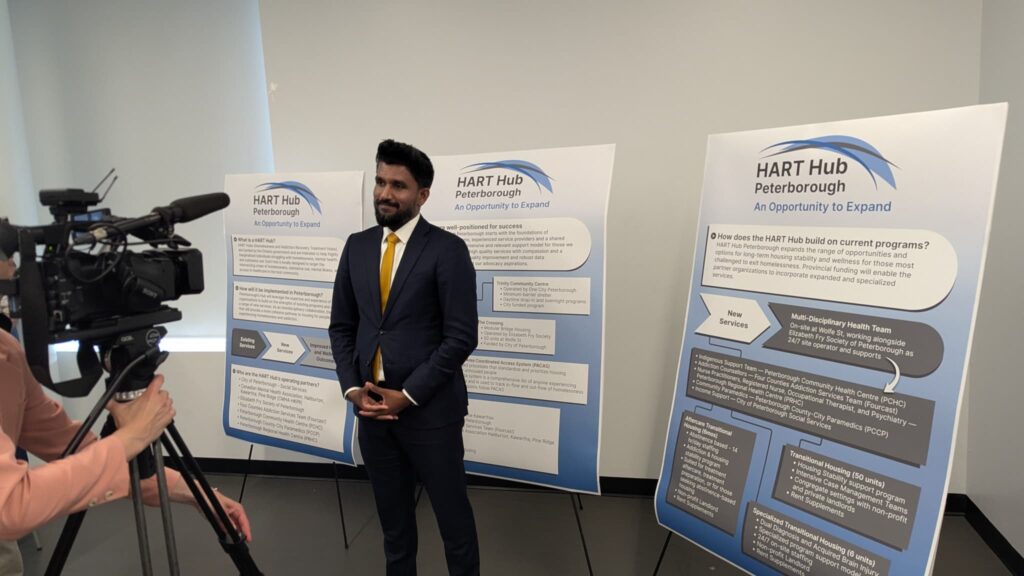
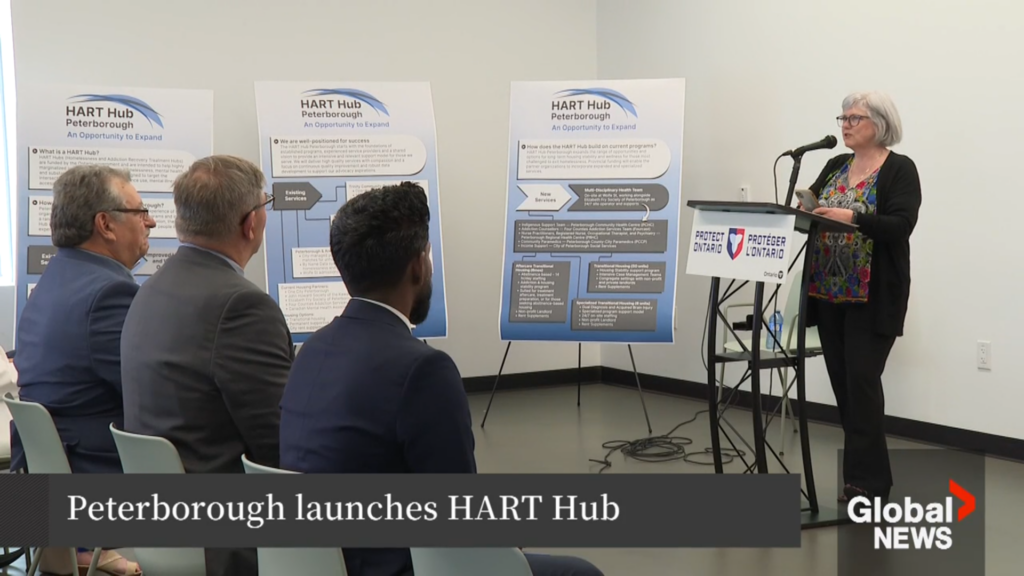
At a launch event at Miskin Law Community Centre on Friday, Peterborough–Kawartha MPP Dave Smith described Peterborough’s Hart HUB as a “conceptual hub,” rather than a specific location, integrating existing services provided by 11 different partner non-profit organizations and government agencies, and supplementing those with new offerings.

In addition to a new multi-disciplinary health team that will be on site at The Crossing modular housing community on Wolfe Street, HART Hub brings 62 new units of transitional housing to the city.

This includes 50 units of standard transitional housing spread across Peterborough, intended as a next step for those currently housed in The Crossing community, as well as two specialized housing projects: a six-unit development with 24/7 staffing for those with complex dual diagnoses, and another six-unit development for those in substance use recovery, which is described as an “abstinence-based” housing model.

This announcement is part of a significant shift by the provincial government in how it handles substance use and treatment. The original announcement of HART Hub funding in late 2024, for Peterborough and 28 other sites across the province, was paired with dramatic new restrictions for CTS services. This ultimately led to the defunding of all CTS sites across Ontario earlier this year, and the closure of most sites, including in Peterborough.

“Our government doesn’t believe in providing tools for the most vulnerable in our communities to use illicit drugs,” said Vijay Thanigasalam, Associate Minister of Mental Health and Addictions, who was present at the launch event. “Instead, we believe in providing recovery and treatment, breaking the cycle of addiction.”

MPP Smith mirrored these comments, repeating to reporters a previous talking point that “harm reduction without treatment is palliative care. They will die of their addiction if all they have is harm reduction. You’re not solving the problem.”

Earlier this month, Lakelands Public Health CEO, Dr. Thomas Piggott warned of the major health consequences that could be caused by closing the CTS site. Studies have shown that CTS services reduce overdose-related deaths, reduce emergency room visits, and help to forge relationships of trust between those with addictions and social services agencies, which can eventually lead to them seeking treatment.

“People are going to die as a result of this decision,” said Dr Piggott of the CTS closure.

HART Hub “is a completely different response model” than the CTS sites, said Donna Rogers, executive director at Four Counties Addiction Services Team (Fourcast), speaking at the HART launch. Fourcast ran the local CTS site until its closure, and is now a major partner in the local HART Hub. “There is nothing [in the HART Hub model] replacing a safe location to use drugs,” said Rogers. 

Without a CTS site, Rogers said that there will be a “heavy reliance” on One City Peterborough, which operates the low-barrier shelter and homeless services hub at Trinity Community Centre. “One City really is the epicentre of triaging, system navigation, and support for base needs within this community.” 

One City is a partner in the HART Hub project, assisting with the development of transitional housing rental units and supporting those still at The Crossing, but HART funding does not include any additional support for Trinity or harm reduction work.

HART Hub launches as province shifts to recovery and treatment model — KawarthaNOW

Led by Fourcast, the hub will provide on-site healthcare at Wolfe St. modular housing community, transitional housing, supportive housing, and a sober-living program

Article by Bethan Bates, KawarthaNOW

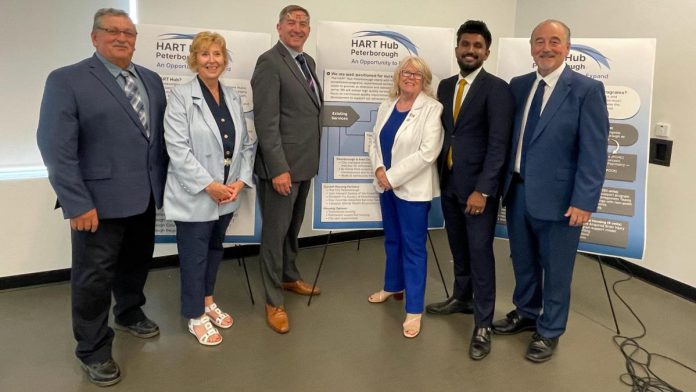
Community leaders and representatives of municipal and provincial governments gathered at the Miskin Law Community Complex on Friday morning (June 26) to mark the launch of the Homelessness and Addictions Recovery Treatment (HART) Hub in Peterborough.

The Ontario government is providing $6.3 million in annual funding to support Peterborough’s HART Hub, which will provide transitional and supportive housing and addiction services as well as healthcare services at 210 Wolfe Street — the site of the City of Peterborough’s modular housing community for people experiencing homelessness.

Peterborough is one of 29 HART Hubs funded by the province representing a total investment of more than $560 million.

Recovery and treatment model focused on residents of Wolfe Street modular housing community

“This historic investment will change the lives of many people in our community,” said Donna Rogers, executive director of the Four Counties Addictions Services Team (Fourcast), the lead organization for the HART Hub.

Those attending Friday’s event included municipal politicians Peterborough-Kawartha MPP Dave Smith, Haliburton-Kawartha Lakes-Brock MPP Laurie Scott, and Scarborough-Rouge Park MPP and associate minister of mental health and addictions Vijay Thanigasalam, along with local politicians including Peterborough mayor Jeff Leal, Peterborough County warden Bonnie Clark, Trent Lakes mayor Terry Lambshead, and Selwyn Township deputy mayor Ron Black, who is also board chair of Fourcast.

“I want to applaud the provincial government for their generous investment in our local HART Hub model,” Black said. “Your investment vision allowed local innovation and design, leveraging the expertise and experience of our local partners.”

MPP Smith, who has been an ardent supporter of the HART Hub, described its continuum of services as a “buffet” with a number of entry points.

“We’re giving them the opportunity to be reintegrated back into society, to be part of the community again and it’s something that we haven’t seen in a very long time,” Smith said of HART Hub clients.

For his part, MPP Thanigasalam shared stories from other HART Hubs and spoke of the Ford government’s focus on “breaking the cycle” of addiction by focussing on recovery and treatment.

“This is a comprehensive recovery treatment hub,” Thanigasalam said. “You can go through, get the treatment you need, and go through the journey all the way to employment training as well.”

Long-term housing stability for unhoused people with addiction and mental health issues is the goal

Rogers said that the Peterborough HART Hub will provide specialized services to individuals living at the Wolfe Street modular housing community to enable them to secure supportive and long-term housing.

“Our unique model puts a laser focus on long-term housing stability for those with few housing options,” Rogers said. “We believe that housing is the solution for those in our community facing the intersecting crisis of addiction, mental health, and homelessness.”

The Peterborough HART Hub will operate four new services: an on-site healthcare team at Wolfe Street integrated with existing frontline staff from the Elizabeth Fry Society of Peterborough (EFry), 50 units of transitional housing for residents moving out of modular housing, six spaces of supportive housing hosted by the Canadian Mental Health Association – Haliburton, Kawartha, Pine Ridge (CMHA HKPR) for individuals with acquired brain injuries or a dual diagnosis including developmental disorders, and a six-month “sober living” program for people who are unhoused when entering addictions treatment.

Healthcare organizations involved in the HART Hub include the Peterborough Community Health Centre, Peterborough County-City Paramedics, and the Peterborough Regional Health Centre.

In an interview with kawarthaNOW in May, Rogers spoke about the design and values of the HART Hub and described how they intend to operate their services.

“Our goal is long-term stable housing, with the appropriate supports for the people who are the most complex in our community,” said Rogers.

Specialized supports for modular housing community residents with complex needs

Fourcast and partners identified the residents of the Wolfe Street modular housing community as being highly complex due to the intersection of challenges with mental health, disability, addictions, and homelessness.

In particular, Rogers said that this is a population that does not have reliable access to primary care or specialized healthcare, which leads to health issues becoming more severe and complex. The on-site health team established by the HART Hub funding will address this disconnection and provide essential care to residents.

“This is a responsive and accessible model of healthcare,” said Rogers.

The 50 units of transitional housing will be provided in partnership with private and non-profit landlords, including One City Peterborough through their additional rental unit (ARU) developments.

Rogers said that securing and maintaining housing is difficult for individuals experiencing chronic homelessness, especially residents of the Wolfe Street modular housing community who require low-barrier entry to services and shelter.

“Finding housing units is not easy — housing is not available for the people that we are trying to serve,” Rogers said.

Correen Day, director of services for EFry, spoke to kawarthaNOW about the challenges that Wolfe Street residents face when working towards transitioning out of chronic homelessness.

“We’re seeing intersections with our criminal justice system and with our healthcare system based upon the way they’ve had to survive over the time that they were homeless,” Day explained.

Day said that having on-site supportive services at all stages of the HART Hub system creates an accessible route for transition out of Wolfe Street for individuals who require additional support.

The HART Hub will provide specialized support for individuals with acquired brain injury or dual diagnosis including developmental disorders through the six spaces hosted by CMHA HKPR.

Kerri Kightley, director of programs and services at CMHA HKPR, said that securing housing for people with many co-occurring conditions and health issues as the care required is much more specialized, and therefore, more limited.

“I think we’re just looking at how we build small steps so that people have more opportunities to then live more independently and in housing that they choose,” Kightley said.

The six-month sober-living program that will serve unhoused people entering addictions treatment is the only HART Hub program that will require abstinence for participation, Rogers told kawarthaNOW.

A philosophical shift away from supervised consumption sites

Although the Ford government has positioned the HART Hubs as a replacement for now-defunct Consumption and Treatment Sites (CTS), Rogers described the transition from the CTS model to the HART Hub model as a “philosophical shift,” further saying, “it’s doing diametrically different things.”

A response to the opioid crisis, Peterborough CTS’s opened in June 2022 in the former bus terminal at 220 Simcoe Street in downtown Peterborough to provide a safe and medically supported space for people to consume pre-obtained drugs under the supervision of health professionals.

On March 16, the Ontario government announced it would end funding for seven CTS sites in communities that now have a provincially funded HART Hub, including Peterborough, with a “90-day wind-down period … to give clients time to transition to the support provided by their local HART Hub.”

Like all HART Hubs, the Peterborough hub will not offer safer supply, supervised drug consumption, or needle exchange programs.

When asked about the transition from a consumption-based model to an abstinence-based model, Thanigasalam said the Ford government is responding to calls for funding for recovery services.

“Our government doesn’t believe in providing tools for the most vulnerable communities to use drugs. Instead, we believe in providing recovery and treatment by breaking the cycle of addiction,” said Thanigasalam.

He further said that the investment in the HART Hub program is four times larger than what had been provided to operate CTS sites.

For his part, MPP Smith reiterated his position that “Harm reduction without treatment is palliative care.”

City’s HART Hub offi­cially opens — Peterborough Examiner

Facil­ity aims to provide hous­ing and recov­ery sup­port

Article by Sebastian Johnston-Lindsay, Peterborough Examiner

Peterborough’s Homelessness and Addiction Recovery Treatment (HART) Hub is officially operational nearly two years after the province of Ontario announced the system.

Peterborough’s HART Hub was unveiled in January of 2025 alongside more than $18 million in funding over three years. It is one of 29 throughout the province and represents a total investment of $560 million.

Kingston’s hub is set to open in the coming months.

Project is focused on long-term housing stability

Led by Four Counties Addiction Services Team (Fourcast) as the funded agency, Peterborough’s model consists of partnerships with local agencies such as the Canadian Mental Health Association (CMHA), Elizabeth Fry Society, One City, Peterborough City-County Paramedics (PCCP), Peterborough Regional Health Centre (PRHC) and the Community Health Centre (CHC).

“Our unique model puts a laser focus on long-term housing stability for those with housing options,” said Donna Rogers, executive director of Fourcast, during a launch event on Friday held at the Miskin Law Community Complex.

“We believe that housing is the solution for our communities facing the intersecting crisis of addictions, mental health and homelessness.”

The Peterborough hub consists of four components, Rogers explained. It begins with the 50 units of transitional housing at the Wolfe Street modular bridge housing community.

Additionally, six units of abstinence-based transitional housing and six more for housing for individuals exiting Wolfe Street, with dual diagnosis and acquired brain injury.

Creation of non-profit housing options integral

The significance of having non-profit partners in the CMHA and One City to make housing units available for the population the HART Hubs will serve is pivotal as well, Rogers said.

Kerri Kightley, CMHA director of programs and service, told reporters her organization operates a large supportive housing department. It is working as part of the HART Hub model to purchase housing for those accessing its services.

“We’re really interested in looking for solutions across the housing continuum and how we can use our assets as equity to purchase additional housing and that’s what we’re interested in contributing,” Kightley said of the total 10 housing units the CMHA is contributing to the HART Hub system.

“We’re always looking for more opportunities to expand that and we work fairly closely with Forecasts around supportive housing,” Kightley added.

“We’re really looking for ways that our funding can help boost this funding and or where we have some expertise or they have some expertise that can enhance one another’s programs.”

In her remarks Friday, Rogers highlighted the impact of current and economic conditions, which are “growing homelessness at a rate that is unprecedented. People cannot afford food and shelter, so record numbers are becoming unhoused.

“This is coupled with a housing crisis where the rental market is limited, expensive and competitive. The people we see in our communities and on our streets cannot compete for scarce housing.”

Associate Minister of Mental Health and Addictions Vijay Thanigasalam was also present for Friday’s announcement.

“We have to continue to build more infrastructure, bring companies to set up shop here in Ontario and continue to provide and create new jobs,” Thanigasalam said in response to media questions around how the government is working to prevent people from falling into homelessness in the first place.

“That’s exactly what we are focusing on. We need the economy to provide mental health addiction and recovery funds and the $560 million is part of the expansion of that model.”

Model represents shift from previous approach to addictions and homelessness

The announcement of the HART Hub model was made simultaneously with the Ford government’s decision to shutter nine consumption and treatment service (CTS) sites within 200 metres of schools and child-care centres.

Earlier this year, the government announced funding for all remaining CTS sites in the province would end, including the one which operated in Peterborough since 2022, which closed its doors at the end of May.

Rogers noted the CTS operated as part of “a completely different response model” to the HART Hub system. In the wake of its closure “one would assume that the need is still there, but the (drug) use is happening in other locations.”

However the role the CTS played in helping direct people to services within the city will now be dependent upon One City, which Rogers called “the epicentre of triaging and system navigation and support.”

‘This is going to be a costly decision’: Fourcast warns of impacts from shutdown of Peterborough CTS — KawarthaNOW

Despite optimism over new HART Hub, executive director says lack in supervised consumption services will increase pressure on emergency services, policing, and public spaces

Article by Bethan Bates, KawarthaNOW

With the closure of Peterborough’s Consumption and Treatment Site (CTS) looming, community leaders are voicing their concerns about the potential impacts on service users and the community at large.

“From a service user perspective, you are removing a very important place where they start the foundations of making change to recovery,” said Donna Rogers, executive director of Four Counties Addiction Services Team (Fourcast), in a recent interview with kawarthaNOW.

On March 16, the Ontario government announced it would end funding for seven CTS site in communities that now have a provincially funded Homelessness and Addiction Recovery Treatment (HART) Hub, including Peterborough, with a “90-day wind-down period … to give clients time to transition to the support provided by their local HART Hub.”

Closure a result of provincial policy shift away from supervised consumption and harm reduction to treatment and recovery

The decision to close Peterborough’s CTS comes almost two years after the Ontario government’s August 2024 “safer communities” announcement of a policy shift to restrict harm reduction sites and make addiction treatment a priority, banning supervised drug consumption sites within 200 metres of schools and child care centres.

The announcement resulted in the closure of nine provincially funded CTS sites, including four in Toronto as well as sites in Guelph, Hamilton, Thunder Bay, Ottawa, and Kitchener-Waterloo.

At the same time, the provincial government announced a $378 million investment, later increased to almost $500 million, for new HART Hubs focused on treatment, recovery, and housing, and issued a province-wide call for proposals, encouraging the nine closed CTS sites to submit proposals to transition to HART Hubs.

In January 2025, the province announced the nine closed drug injection sites would be transitioned to HART Hubs and also announced additional HART Hubs would be created, including one in Peterborough, ultimately resulting in 28 across Ontario.

A response to the opioid crisis, the Peterborough CTS opened in June 2022 in the former bus terminal at 220 Simcoe Street in downtown Peterborough to provide a safe and medically supported space for people to consume pre-obtained drugs under the supervision of health professionals.

People using the CTS are provided with sterile injection supplies, education on safer consumption practices, drug checking, basic medical services, and referrals to addiction treatment services, housing, and other social services.

Rogers explained that such sites were funded to provide the singular function of offering a safe space and clean supplies for the use of personal illicit drugs.

“We weren’t a drop-in spot, you couldn’t loiter around, and you couldn’t have tents,” she said.

Lack of supervised consumption expected to increase emergency calls and public drug use

Following the closure of the first nine CTS sites, the Canadian Drug Policy Coalition tracked calls made to emergency services and visits to the emergency department for opioid-related overdoses.

A release from the Coalition says “Ontario-wide data shows a sharp increase in EMS calls (+69.5%) and emergency department use (+67%).”

Rogers said this data is worrying and representative of the importance of supervised consumption in the healthcare and recovery continuum. For her, it is clear people will continue to need the services provided at the CTS, but the closure will leave them with nowhere to go.

“These uses will happen somewhere else,” said Rogers of the approximate 300 uses per month supervised at the Peterborough CTS.

Furthermore, Fourcast works in partnership with paramedic and emergency medical services to function as an alternate drop-off location for individuals experiencing drug-related medical complications — a service that will also no longer be available when the CTS is closed.

The Ontario government cited concerns about public safety around CTS locations as a primary reason for the closures. However, for Rogers, the real concerns around safety will come after the CTS is closed and a gap in services has been created.

In particular, she said that when the Peterborough CTS is closed, even temporarily, the immediate surrounding area feels the impact.

“If we closed for an hour or two we would notify the library,” said Rogers, referring to the main branch of the Peterborough Public Library, which is located half a block south of the CTS.

Prior to the opening of the CTS, drug-related emergencies were a common occurrence in and around the library. In a report presented to the library board on May 12, library director and CEO Melissa Reddenit noted the library is preparing for the closure of the CTS with several steps related to safety and security.

Rogers also foresees the closure impacting police response and public works as people continue to use, although now in public spaces.

Further, Rogers said a major impact of the CTS closures will be increased costs for municipal policing and public services “downloaded” from the province.

“This is going to be a costly decision on the city,” said Rogers.

HART Hubs do not offer safer supply, supervised drug consumption, or needle exchange programs

Following the closure of the CTS, Fourcast will begin the operation of Peterborough’s provincially funded HART Hub. Peterborough is one of 28 communities approved for HART Hub funding, having secured $6.3 million through a joint proposal between Fourcast and the City of Peterborough.

In its March 16 announcement of the latest CTS closures, the province stated the goal of HART Hubs was to “fund treatment and lasting recovery from addiction, rather than continued public funding of drug injection sites.”

“It’s a philosophical shift — it’s doing diametrically different things,” said Rogers of the HART Hub system.

Like all HART Hubs, the Peterborough hub will not offer safer supply, supervised drug consumption, or needle exchange programs. Eligible activities under HART Hub funding include, but are not limited to, primary care, mental health and addictions services, supportive housing, case management, and drop-in services.

“The HART Hubs are all different,” explained Rogers.

Rogers told kawarthaNOW he Peterborough HART Hub will focus its efforts on providing healthcare and housing supports to residents at the modular bridge housing community on Wolfe Street.

Owned and funded by the City of Peterborough and operated in partnership with the Elizabeth Fry Society of Peterborough (EFry), it consists of 50 modular housing units with 24/7 onsite support for individuals with complex needs that cannot be met at low-barrier overnight shelters.

“The people on Wolfe Street can’t stay at the shelter because they have service restrictions,” said Rogers.

Focus of Peterborough’s HART Hub will be healthcare and traditional and supportive housing

When assessing how to use the $6.3 million investment for Peterborough’s HART Hub, Fourcast and community partners established that their focus should be to establish “long term stable housing, with the appropriate supports, for the people who are the most complex in our community.”

Rogers explained that individuals experiencing chronic homelessness are more likely to have complex physical and mental health needs due to a lack of access to healthcare, ultimately making finding and maintaining housing an ongoing challenge.

“They are some of the most complex healthcare patients you could ever imagine,” said Rogers.

To address the barriers faced by Wolfe Street residents, the Peterborough HART Hub will develop a healthcare team to work in partnership with the existing EFry frontline staff.

In addition to the onsite health team, the HART Hub will operate 50 units of transitional housing for residents moving out of Wolfe Street housing, a further six spaces in supportive housing hosted by the Canadian Mental Health Association – Haliburton, Kawartha, Pine Ridge (CMHA HKPR) for individuals with acquired brain injuries or a dual diagnosis including developmental disorders, and finally, a six-month “sober living” program for people who are unhoused when entering addictions treatment.

Fourcast is also working in collaboration with One City Peterborough to use newly built, single-occupant additional rental units (ARUs) as transitional housing units for individuals with complex needs requiring ongoing support.

Recognizing that other municipalities have elected to develop drop-in programs and homelessness response hubs, Rogers said the existence of the Trinity Community Centre operated by One City has allowed Fourcast to take a more targeted approach.

“We already have a homelessness response hub,” said Rogers. “This allowed us to take a laser focus on housing and housing stability.”

Despite optimism about the positive impact of the HART Hub, Rogers said it should not be seen as a replacement for the services provided by the CTS.

“There’s a discussion that it’s a direct trade off, but it certainly is not,” she said.

Fourcast Seeking Applicants to Join Our Board of Directors and Help Serve Our Community

Four Counties Addiction Services Team (Fourcast) is looking for community-minded people who want to make a difference by serving on our Board of Directors.

Our Board plays a vital leadership role in guiding Fourcast’s strategic direction; upholding our mission, vision, and values; serving as financial stewards; and supporting continuous quality improvement.

“Fourcast has experienced tremendous growth and significant expansion of our services over the past five years, and we are very proud of this growth and of the organization,” said Ron Black, current Board Chair. “At this pivotal phase, we need forward-thinking leaders with the ability to work well in a team environment and a willingness to be a spokesperson and advocate for those struggling with addiction. New Board members will join a group of dedicated volunteers who contribute their time and talent to help the organization deliver high-quality programs in service to our communities.”

Fourcast welcomes applicants with experience in Non-Profit Governance, Government Relations, Communications, and other areas of expertise that would make them strong contributors to our Board.

“As Fourcast navigates this next chapter of growth in the area of Bed-Based Addiction Treatment Services and leading our community’s innovative Homelessness Addiction Recovery and Treatment (HART) Hub model, we are looking for visionary leaders who can help us leverage these new opportunities,” said Donna Rogers, Executive Director. “A strong, diverse Board of Directors is critical to ensuring that Fourcast continues to meet the evolving needs of our community.”

Applications will be open until May 15, 2026. For more information or to apply, please visit www.fourcast.ca/board-recruitment.

Contact:
Meghan Moloney, Communication Coordinator, Fourcast
705- 931-2839, mmoloney@fourcast.ca

“Peterborough’s HART Hub is taking shape, but more affordable housing is needed” — Peterborough Examiner

Peterborough was one of 27 communities in Ontario to be approved for HART Hub funding in January 2025.

HART Hub funding is flowing into Peterborough and the work of building up the region’s response to treating mental health and addictions while addressing homelessness is well underway, says the executive director of Four Counties Addictions Services Team (Fourcast).

Donna Rogers explained the work is “a focused approach based on consolidating some of the planning and some of the decisions that city council made,” specifically around the decisions to fund One City’s Trinity Shelter and the Modular Bridge Housing Community on Wolfe Street.

Peterborough was one of 27 communities in Ontario to be approved for Homelessness and Addiction Recovery Treatment (HART) Hub funding in January 2025 and is set to receive more than $18 million from the province over a three-year period to support the project.

“When you opened up the modular community, you moved 50 people instantaneously out of encampments,” she explained, while underscoring that the goal of the HART Hub network is to open and manage the movement of people from spaces like Wolfe Street through to transitional housing, treatment, and then hopefully into affordable permanent housing.

Rogers refers to the movement of people within this system as “shifts”, illustrating movement between varying levels of care and support.

Under the existing HART Hub model, there are 40 units of transitional housing available across the city with an additional six units, run through the CMHA, reserved for people exiting Wolfe Street with acquired brain injuries or dual diagnoses, which present challenges to securing and maintaining housing. Those six units are staffed 24/7 and are rent supplemented.

“There won’t be 40 people exiting there at the same time,” Rogers explained, noting the difference between the opening of Wolfe Street and the model established under the HART Hub.

“As people are ready, and as we can find units, it’ll be a bit of a slower trickle off Wolfe Street, but every time we move someone off the site, someone can move on the site.”

Through the HART Hub model, one individual has been moved from Wolfe Street, Rogers said, but hopefully that will speed up as hiring continues and the services are established.

Meanwhile, another six units are reserved for individuals who are entering housing out of homelessness following their choice to enter [bed-based] addictions treatment. These units are meant as a form of aftercare, lasting six months post-treatment, and allow individuals to be fast-tracked into available transitional housing, Rogers explained.

Fourcast is working as part of a larger team of health-focused organizations and community partners on the implementation of the HART Hub locally. The partners involved include PRHC, One City, CMHA, Elizabeth Fry Society, Peterborough City-County Paramedics, and the Community Health Centre.

“All of those partners have different parts to play in implementation of the HART Hub, so we have been doing a lot of work around planning and designing the four different structures or components of the HART Hub as we implement them,” Rogers said.

A small portion of HART Hub funding was earmarked for capital projects, which includes renovations to the main building located at the Wolfe Street Project which will house a health team consisting of nurse practitioners, psychiatrists, addictions case managers, and Ontario Works social services staff.

The nurse practitioner positions are being actively recruited through PRHC while Fourcast is working toward hiring two intensive case manager positions and housing support workers who will operate with a caseload of between 15-20 people. The roles entail helping to identify and work with individuals living at Wolfe Street or making use of Trinity’s overnight program who are ready to move into transitional housing.

Wolfe Street, Rogers explains, targets the more complex cases of people looking for homes, meaning that the work of the HART Hub is specialized and targeted while also flexible enough to operate between different levels.

It also goes some way to explain why, as councillors asked last week, an organization like Redpath — which the city just granted $150,000 to support planning for a transitional housing project — had not been involved in the planning and therefore not eligible for the provincial funding.

The differences also extend to the point that the only part of the HART Hub model dependent upon complete abstinence from substances being required is the six units for post-treatment housing.

There’s a specific reason for that, Rogers said: “Wolfe Street, and the folks that Fourcast admits into our existing transitional housing programs under the city, is a population for whom abstinence at point of admission into housing is a barrier to housing.”

“We’re talking about the population that’s signing on to getting off the street and getting into housing as a starting point,” she added.

The focus on building transitional housing, including HART Hubs, Redpath, and a planned development by the Brock Mission too, means that within a few years there will be an issue in terms of where people who are living there will go. Under provincial legislation, transitional housing is specifically time-limited, allowing residents to stay up to four years, and includes exemptions under the residential tenancies act.

This point, Rogers says, means that there needs to be increased investment in the creation of permanent affordable housing in the region to avoid bottlenecks which are only just beginning to ease at Wolfe Street as a result of the HART Hub investments.

“If transitional housing is time-limited, there’s probably a formula that says for every transitional housing unit you have, every 10 years you’re probably going to need three to four affordable housing units,” Rogers said. “If we robustly support transitional housing, we have to be thinking we’re creating a problem three to four years down the road.”

Locally, two “shovel ready” projects supported by Peterborough Housing Corporation (PHC) have been stalled since 2024 due to a lack of available funds from the province and the federal government.

Both Rogers and MPP Dave Smith told the Examiner that it’s too soon to know exactly what future rounds of HART Hub funding would look like at this time, and what, if any, changes might be made to the expectations.

Rogers noted, however, that the information gathered over the next two years would help inform how the programs will be utilized.

By Sebastian Johnston-Lindsay, Reporter
February 9, 2026

Fourcast Launches Recruitment Campaign for New Bed-Based Addiction Treatment Facility

Addiction treatment in our community has just reached a major milestone. The Four Counties Addiction Services Team (Fourcast) is proud to announce that the renovation of the historic Paddock Wood house is now completed, and we are moving into the next phase of the project by launching a staff recruitment campaign for the new services that will be housed at the site.

Visit our Careers page to see all available positions

Beginning on Monday, May 5, Fourcast will be recruiting a full complement of staff to run the highly anticipated bed-based programs, which include a 35-day addiction treatment program and a 5 to 7-day withdrawal management program. Developed over the past two years, the services will align with the current best practices for addiction treatment and withdrawal management and will allow Fourcast to add this vital new service to our existing program options

“We are incredibly excited to be moving forward with setting up our new facility and getting closer to opening the doors at Paddock Wood,” said Donna Rogers, Executive Director at Fourcast. “The biggest variable in predicting when we will be able to open these programs to the community is getting staff in place. We are committed to having the right people in the right roles so that we can ensure that we are offering the highest quality programming and meeting the highest standards of care to those receiving our services.”

Fourcast’s new programs will require a team of highly trained professionals to operate services that will see male-identifying participants residing on-site 24 hours a day. The agency will be recruiting for a wide range of roles, including full-time and part-time staff, day and night shifts, in different capacities from addictions and withdrawal management workers to food services and overnight care workers.

Ms. Rogers added, “Just as we do for our community-based treatment programs, we place the utmost importance on employing qualified, experienced, and compassionate professionals who will uphold our values in every interaction with our clients.”

There is currently no bed-based treatment available in the region of Peterborough, causing many people to travel to Oshawa, Kingston, or Barrie to get the help they need. Adding local bed-based services will allow Fourcast to complete the continuum of services from early-access and harm reduction services to full 24/7 care.

“As we heard from many community service agencies, government partners, and healthcare partners during the early stages of approving this initiative, Peterborough and its surrounding counties have a critical need for this program as part of the continuum of substance use services,” Ms. Rogers said. “By providing 12 new units of bed-based addiction services to the community, we will be able to get people into this intensive level of treatment much more quickly and much closer to home.”

The new programs will be located in a house in the Paddock Wood subdivision in the north-east end of Peterborough. The 160-year-old building, formerly used by the Canadian Mental Health Association Haliburton Kawartha Pine Ridge (CMHA), has been extensively renovated to meet the need for a bed-based service location.

Fourcast will be posting jobs on our website at www.fourcast.ca/about-us/careers and will share widely with community partners and on social media.

Fourcast thanks the Ontario Ministry of Mental Health and Addictions, the City of Peterborough, and Peterborough County for contributing to the funding for Paddock Wood.

PRHC opens barrier-free downtown clinic, providing rapid access to treatment for patients with opioid and alcohol addictions

PRHC Press Release

April 12, 2017 (Peterborough) – Peterborough Regional Heath Centre (PRHC) is pleased to announce the recent opening of the area’s first Rapid Access Addiction Medicine (RAAM) clinic, which provides expedited, barrier-free treatment for patients who are addicted to alcohol or opioids.

The clinic is staffed by PRHC physicians and registered nurses (RNs). No booked appointment or physician referral is necessary, although referrals from doctors, nurses, social workers, addiction counselors and community providers are welcome.

“Our Rapid Access Addiction Medicine clinic provides immediate access to lifesaving treatment by offering same-day counselling and addiction medication, and prescription therapies,” said Dr. Jim McGorman, an Emergency Department physician with PRHC who is now also treating patients at the new clinic. “This care model has been shown to help save lives by engaging patients with both short- and long-term therapies as soon as they are ready to pursue those treatments.”

The Rapid Access Addiction Medicine model is designed to initiate therapy for opioid or alcohol addiction and then triage clients to the most appropriate ongoing care provider. It is not intended to replace or duplicate the care provided by a family physician or a treatment clinic. The Peterborough RAAM clinic is working closely with other healthcare providers and resources in the community to ensure patients have access to additional supports following their initial treatment, as they move through the continuum of care.

PRHC’s RAAM clinic has been made possible through a $200,000 commitment from the Ministry of Health and the Central East Local Health Integration Network (LHIN). The RAAM clinic model has been implemented in cities across Ontario, where it is helping to prevent opiate overdoses and reduce ED visits and inpatient stays for people with addictions.

“The Central East LHIN, together with the Ministry of Health and Long-Term Care and our health service provider partners, is committed to improving access to comprehensive care for people living with substance abuse disorders,” said Deborah Hammons, CEO of the Central East LHIN. “We look forward to seeing how the opening of the Rapid Access Addiction Medicine (RAAM) clinic at Peterborough Regional Health Centre will have a positive impact on our ability to support individuals dealing with an opiate addiction by providing them with timely treatment, counselling and other supports. The development and implementation of RAAM clinics in Oshawa, Scarborough and now in Peterborough is an important part of the recently released Central East LHIN Opioid Strategy as we collectively respond in an integrated and coordinated way to addressing the opioid crisis in each of our sub-regions.”

The RAAM clinic has been operating in its downtown location at 159 King St. Suite 302 (co-located with PARN) since March 5. It is open Mondays, Wednesdays and Fridays from 8:00 a.m. to 11 a.m.

For further information, please contact:

Michelene Ough
Director, Communications
Peterborough Regional Health Centre
705-743-2121 x. 4259
mough@prhc.on.ca how to spot fake carrera sunglasses
timex indiglo watches replica watch straps uk replica
how can you tell a rolex is fake bvlgari bvlgari watch price replica